
DfE Education Estates Strategy & DfE School estate management standards
The Education Estates Strategy: why this decade demands system level estate leadership
The new Education Estates Strategy lands with a clarity we haven’t seen for years. It is not a funding announcement, it is a structural reset — one that places Responsible Bodies at the centre of a decade long shift from fragmented practice to disciplined, evidence anchored estate management.
For those of us working with schools, trusts and colleges, the direction of travel is unmistakable -
• Renewal, resilience and compliance now depend on organisational systems, not organisational memory.
The Education Estates Strategy and the School Estate Management Standards speak with one voice –
•
If we are going to renew the estate over ten years, we need durable, repeatable, auditable processes that survive turnover and deliver control.
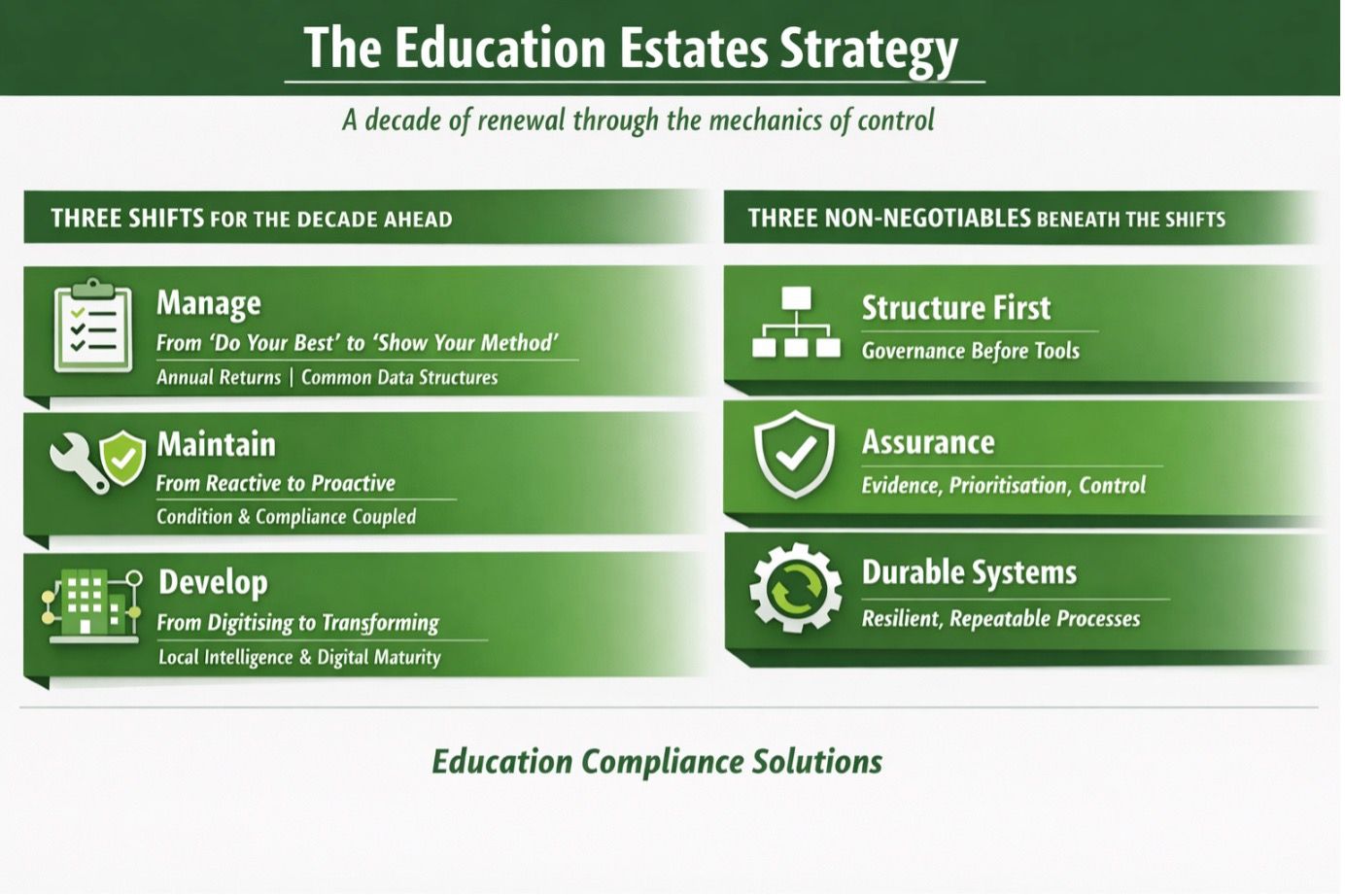
Three shifts now define the next decade
🔹 Manage — from “do your best” to “show your method”
Annual returns, common data structures and the new Manage Your Education Estate reporting service mark the end of informal estate management.
The School Estate Management Standards make this explicit: every Responsible Body must hold accurate condition data, statutory compliance records, asset registers, sufficiency data and energy information — and use them to drive strategic decisions.
This is not about activity. It is about demonstrable control.
🔹 Maintain — from reactive to proactive
The Education Estate Strategy links condition and compliance as two sides of the same system.
Proactive compliance becomes the earliest warning signal for estate decline — and the foundation for climate resilience.
With long term maintenance funding rising to almost £3bn per year and the new Renewal & Retrofit Programme targeting significant condition issues, the expectation is clear
- Planned, preventative, risk based maintenance is now the operating model.
🔹 Develop — from digitising to transforming
Digital maturity is no longer a technical preference — it is a strategic requirement.
Responsible Bodies will collect their own data to a common standard from 2027.
BIM, cyber resilience, climate risk data and digital asset management become core components of “fully effective” practice.
Digital tools only create value when organisations can close loops locally — issues tracked, evidence contextualised, patterns visible.
Three non negotiables sit beneath these shifts
✨ Structure first — not software first
Governance, ownership and expectations must be defined before tools are deployed.
The School Estate Management Standards are unambiguous: estate strategies, asset management plans and compliance registers are the structural backbone and the requirement to comply with Level 1 (Baseline).
✨ Assurance — not activity
Effort is no longer the metric. Responsible Bodies must be able to evidence prioritisation, compliance and risk management — consistently and defensibly.
✨ Durable systems — not heroic effort
The decade ahead demands processes that reduce cognitive load and survive staff turnover, handovers and organisational change.
Continuity planning, statutory logs, risk registers and strategic reviews must become organisational rhythms, not individual habits.
A decade of renewal will be delivered through the mechanics of control
The Education Estates Strategy brings unprecedented long term investment, however, funding alone does not create resilience.
The real transformation will come from the systems Responsible Bodies build now — the routines, reviews, data structures and governance that turn assurance from effort into certainty.
This is the moment for estate management to become a leadership discipline, and if we get the mechanics right, we don’t just fix buildings — we build an estate that finally matches the ambition we hold for our children of today, our communities and our children of the future.
